Autonomous Systems · AI Compute Infrastructure
Infrastructure for autonomous systems and high-density AI computing.
Dagmont is infrastructure for autonomous-system deployment and operation, and for high-density AI compute environments.
Autonomous Systems connects deployment requirements, live operations, evidence, corrective action, retesting, and acceptance. AI Compute Infrastructure covers rack systems, liquid cooling, power, server integration, networking, and validation.
Our businesses
Autonomous Systems connects deployment intelligence with live robot operations. AI Compute Infrastructure engineers and integrates high-density compute systems.
Autonomous Systems
Deployment and operational infrastructure for robotics and physical AI. Products: Deployment Intelligence and Command.
Open Autonomous Systems · Discuss an Autonomous Systems Program
AI Compute Infrastructure
High-density AI computing infrastructure engineering, integration, and manufacturing programs. High-density AI compute infrastructure engineered across rack systems, liquid cooling, power, server integration, networking, and validation.
AI Compute Infrastructure
High-density AI compute infrastructure engineered across rack systems, liquid cooling, power, server integration, networking, and validation.
Dagmont Compute Systems engineers and integrates high-density AI infrastructure across rack systems, liquid cooling, power distribution, server integration, networking, and system validation.
Requirements → architecture → integration → testing → validation

Autonomous Systems
Dagmont is robotics deployment infrastructure for Physical AI: evidence, verification, acceptance, and operational escalation from validation through production.
The post-lab gap
Dagmont connects robot telemetry, field evidence, failed requirements, confirmed causes, corrective actions, configuration changes, retesting, customer acceptance, and operational escalation into one auditable deployment record.
Status meetings, chat threads, and ticket queues scatter context across manufacturers, integrators, customer operators, and reviewers. From field evidence and failed requirements through corrective actions, retesting, acceptance, and production change.


The Autonomous Systems closed loop
Requirements move through deployment, live operation, evidence, investigation, corrective action, retesting, acceptance, and continued operation in one connected record.
- Step 1
Deployment requirement
Define the operating condition, acceptance criteria, site context, and evidence required for verification.
- Step 2
Deploy and operate
Run the robot in its intended environment while Command records state, commands, runs, alerts, and operational context.
- Step 3
Failure and evidence
Connect a failed or degraded condition to logs, video, configuration state, telemetry, and the requirement it affected.
- Step 4
Investigation and correction
Record the confirmed cause, corrective action, ownership, configuration change, and approval history.
- Step 5
Retest and acceptance
Repeat the affected condition, preserve the results, and bind customer acceptance to the verified evidence trail.
- Step 6
Continued operation
Return the system to live operation and escalate recurring or new failures back into the same deployment record.
What each product records
Deployment Intelligence records investigation, change, retest, and acceptance. Command records live supervision, authorized commands, and operational failures.
Dagmont Deployment Intelligence
Faster blocker identification
Failed conditions, ownership, and acceptance context stay in one deployment case.
Inspectable evidence trail
Logs, video, configuration, and notes attach to the condition reviewers must judge.
Verified change and retest
Corrective actions map to root cause, then retest results close the loop.
Defensible acceptance records
Customer decisions bind to finalized reports and the evidence that supported them.
Dagmont Command
Live supervision
Monitor robots, state, connectivity, alerts, and faults from one operational control layer.
Supported operational commands
Dispatch missions and issue authorized high-level commands such as pause, resume, cancel, and return to charge where the integration supports them.
Run accountability
Record who issued commands, acknowledgements, execution state, and operational issues across shifts.
Failure escalation
When a live failure needs structured investigation, Command creates a Deployment Intelligence case with the operational snapshot and related command history.
Two products
Deployment Intelligence owns investigation and acceptance. Command is the operational control layer for supervising and running live robot operations.
Dagmont Deployment Intelligence
Resolve deployment failures, prove corrective action, retest, and record customer acceptance—the auditable system of record for blocked robot rollouts.
Explore Deployment Intelligence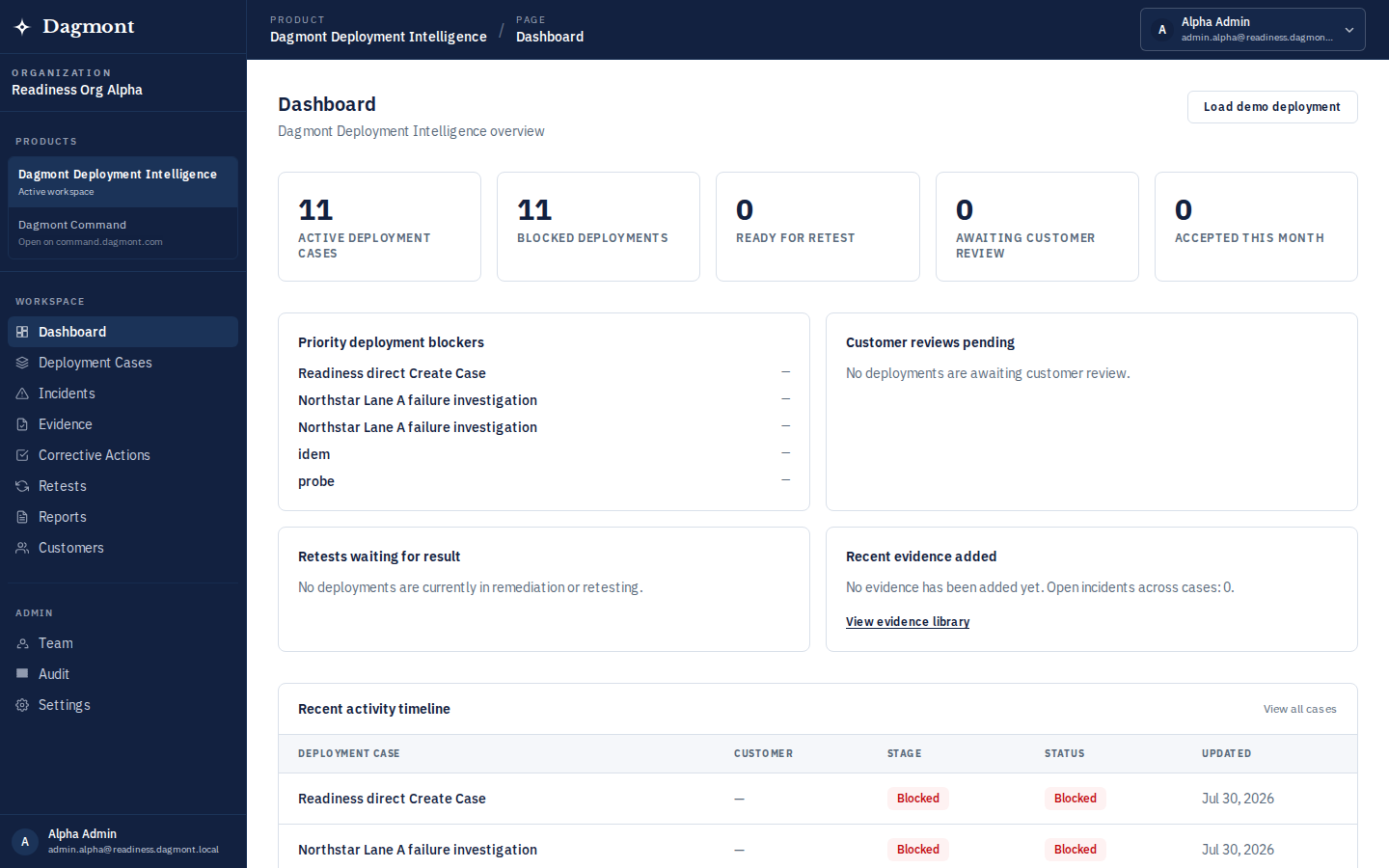
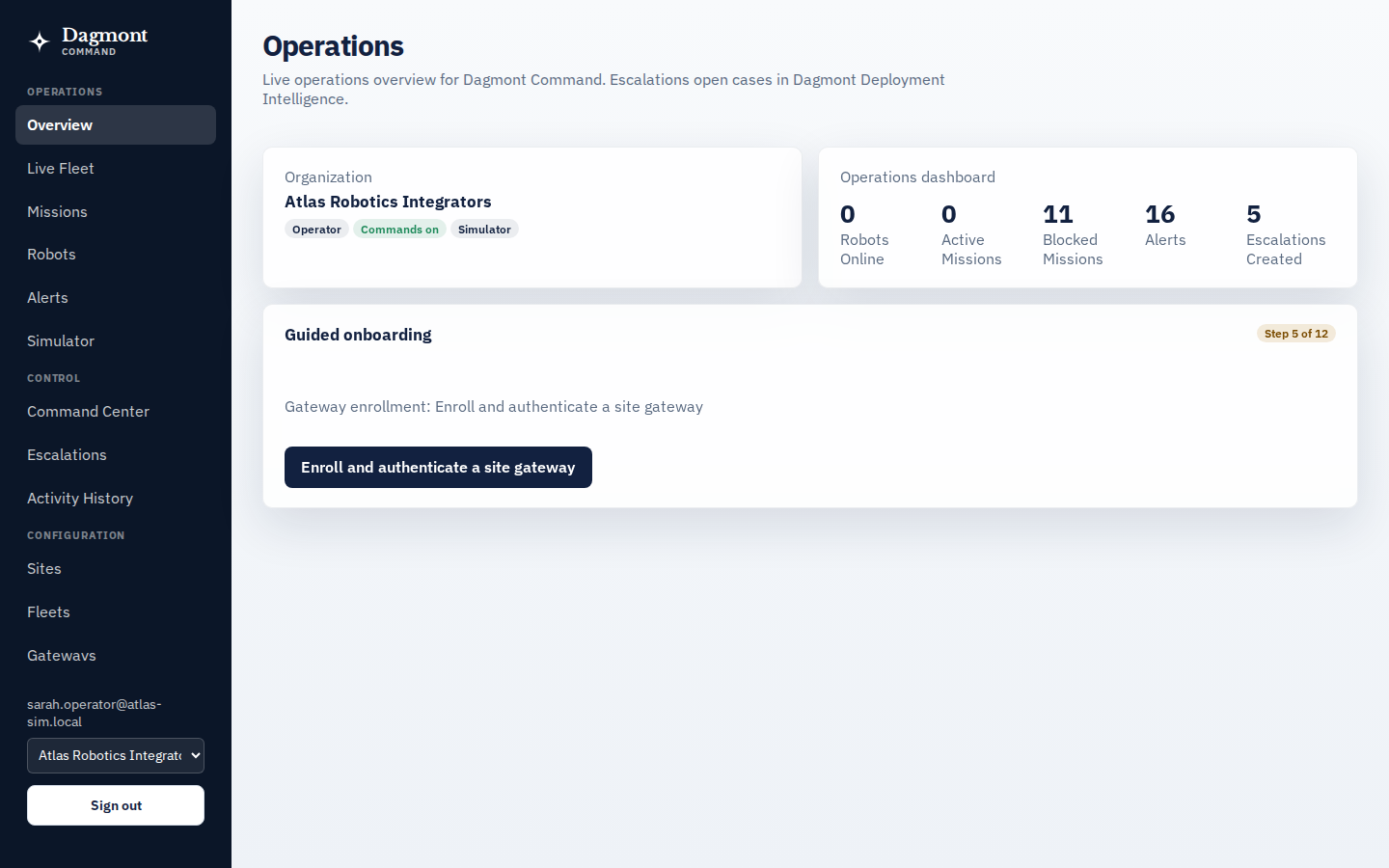
Dagmont Command
Dagmont Command is the operational control layer for supervising live robots, missions, commands, alerts, and failures.
Supervise live robots and robotic machines from one operational control layer. Monitor state, run missions, issue supported commands, record operational issues, and escalate deployment failures with the full operational context attached.
Fleet software runs robot motion and dispatch. Dagmont Command supervises operations, issues authorized high-level commands, records what happened, and escalates failures into Deployment Intelligence.
Explore CommandRobot fleet managementPhysical robot monitoring
How the products work together
Command supervises live operations and issues supported high-level commands. Deployment Intelligence becomes the durable acceptance record after escalation.
| Focus | Deployment Intelligence | Command |
|---|---|---|
| Primary job | Investigation, evidence, retesting, reporting, and acceptance | Live robot operations: supervise, command, and record |
| Who uses it | Manufacturers, integrators, deployment engineers, customer reviewers | Operators and operations leads |
| Connection | Receives escalated cases and becomes the durable acceptance record | Creates Deployment Intelligence cases from blocked live missions |
Deployment Evidence Passport
A structured summary of what failed, what evidence supports the investigation, what changed, what retested, and what the customer accepted.
The Deployment Evidence Passport is the customer-facing distillation of a deployment case: one inspectable record that ties failure, evidence, corrective action, retest results, and acceptance decisions together.
The passport reflects documented deployment work at the time of review. See Security & Trust for how evidence is protected and shared.
Deployment Evidence Passport
- Site
- Site Delta
- Robot
- AMR-200 unit 14
- Stage
- Customer review
Failed condition
Dock alignment tolerance exceeded during acceptance run 7
Evidence linked
4 logs, 2 video clips, configuration baseline v3.2
Corrective action
Dock offset recalibrated, firmware parameter updated
Retest
Acceptance run 8 passed, recorded 2026-07-18
Acceptance
Pending customer reviewer sign-off
Every deployment improves the next
Dagmont turns closed deployment evidence into reusable operational knowledge within authorized boundaries. Teams can identify recurring causes, proven corrective actions, effective retest methods, and customer acceptance conditions across deployments where data rights allow.
Enterprise security for deployment-critical records
Dagmont protects deployment requirements, evidence, corrective actions, retest results, operational history, and customer acceptance records through layered identity, access, isolation, and recovery controls.
- Multi-factor authentication
- Role-based permissions
- Tenant-isolated records
- Server-side authorization
- Evidence provenance
- Administrative audit history
- Encrypted data transmission
- Documented backup and recovery procedures
Who uses Autonomous Systems
Each party in a multi-vendor rollout works from the same evidence trail, with a role-specific view.
Robot manufacturers
Field support teams document firmware, hardware, and site findings when shipped systems fail acceptance testing.
Systems integrators
Commissioning teams record WMS, MES, PLC, and network issues with clear evidence handoffs across vendors.
Customer operators
Site teams see shared evidence, review status, and acceptance conditions without internal investigation noise.
Deployment engineers
Engineers connect hypotheses, corrective actions, configuration versions, and retest outcomes in one case.
Program owners
Rollout leads track blocked sites, ownership, and acceptance readiness across a deployment program.
Security and quality reviewers
Reviewers inspect provenance, configuration baselines, and acceptance evidence before sign-off.
Product focus
Dagmont records deployment documentation, operational coordination, and acceptance work across Deployment Intelligence and Command.
- Deployment requirements, incidents, and evidence
- Corrective actions, configuration changes, and retests
- Customer review and acceptance records
- Live robot supervision, mission dispatch, supported commands, run history, and DI connection
- Reusable deployment intelligence across sites
Dagmont Deployment Review
A structured engagement to assess whether Dagmont fits your deployment program and blocked rollout.
Submit deployment context, current blockers, and acceptance requirements. Dagmont reviews the request and replies with next steps.
Commercial terms use custom pricing based on product access, deployment scope, sites, robots, integration requirements, and support level.
Request a Deployment ReviewStart with the Dagmont business that matches your program
Autonomous Systems covers robot deployment and live operations. AI Compute Infrastructure covers high-density compute engineering, integration, testing, and validation.